Showing posts with label Travelogue. Show all posts

Thursday, 14 May 2015


                                                        Chittorgarh: Where silence speaks a thousand words
(Also published at Cox And Kings)

When I set on my journey to explore the mystique of Rajasthan, I had a long list of places in mind. Jaipur, Udaipur, Jaisalmer, Jodhpur, Ajmer, Pushkar and the very many mighty forts around these places. To be honest, if at all Chittorgarh was to be in the itinerary...... Read More


What comes to mind like a film flash are vivid images of stone carved male and female deities, lost in passionate hunger for sex, striking various poses of love making and ready to take us under their esteemed tutelage....... Read More


We are typical North Indians. Very used to hot summers, less waters, spicy food and speaking Hindi-English-Punjabi-Bengali-Gujarati-Bihari-anything but the Southern State languages. It was my sister who fell in love with a Malayali guy and married him.... Read More


Saturday, 10 January 2015

Chittorgarh: Where silence speaks a thousand words

When I set on my journey to explore the mystique of Rajasthan, I had a long list of places in mind. Jaipur, Udaipur, Jaisalmer, Jodhpur, Ajmer, Pushkar and the very many mighty forts around these places. To be honest, if at all Chittorgarh was to be in the itinerary, it wasn't to be given more than half a day, for it looked not even half as significant as other talked-of places did.

My husband and I reached the trekking point to Chittorgrah Fort in an early December morning. This is what it looked like from a distance - 


Mighty!! Super powerful!
As if having borne the cruelty of intruders and calamities of nature not once or twice but a hundred times. In fact, we were sort of right. As the history has to tell, Chittor Fort fought thirty major battles out of which it lost only three. With every major battle millions of lives, opulence, fame and prosperity were lost and with losing the last battle, Chittor never rose to glory again. The silence of ruins however speaks a thousand stories of chivalry, sacrifice and blood flowing like river down the fort hill. This wasn't just a holiday spot. From the many forts and palaces that we had been to, this one was ALIVE. Waiting to be told and retold and appreciated. 


As we trekked the various points in the huge and mighty fort, we realized that half a day would not be good enough to see even half-the-fort. To be succinct, here are the few landmarks that had the most powerful storytelling:-


(1) Panna's Sacrifice

On one summer night in 16th century within these stone wall Panna, nanny to little prince Uday Singh II, had already fed her beloved son, Chandan and her royal charge, and put them both to bed when she heard loud noises and chaos from a kilometer away distance. Immediately, a servant ran in to tell her that Banbir, the illegitimate claimant to the throne, had assassinated Uday's father in a nearby chamber of the fort and was rushing to behead the little prince. "Young Udai must be saved", that was all Panna was determined about.  She immediately instructed the servant to put the sleeping prince into a large basket and smuggle him out of the fort where she would later join them and then the mother of strength and steel lifted her sleeping son, Chandan, from his bed and placed him on the prince's bed, faking him to pass off as the royal prince. As expected, Banbir burst into the room and slew her son right before her eyes. Watching her son cut to pieces, this woman rose motherhood to a level no commoner can. 


Twelve years later, Uady Singh returned to throne as the King of Mewar. 
The remains of the chamber move one to pride and tears.

(2) Rani Padmini's Jal Mahal

 
Rani Padmini is known to be one of the most beautiful women in the world whose grace and intelligence either brought suitors and claimants to insanity or to dust. She is the uncrowned heroine of Chittor, also one of the bravest woman in Indian history. This is the palace where Khilji caught a glimpse of Rani Padmini in a mirror while she sat on the steps of the Jal Palace. The nerd king instantly lost his mind completely to her beauty. This later led to first major attack on the fort by him which drove Rani to perform the first Jauhar in India, supposedly with 15000 women and children. 

Jauhar! In which, on getting the news of their spouses getting killed in the battlefield, women in the fort along with their little ones were supposed to jump in a forty five feet trench of fire. It is said that one jauhar fire stayed lit for three continuous days after which the fort left nothing behind but a barren land of in-collectible ashes. 


Gosh! This was the creepiest place in the fort, like some live burial ground. Sati, Jauhar, martyrdom, soldier's graves, cold blooded murders, talk of it and you find it here. The silent reverberations of children howling, women mourning and mothers weeping gives  goosebumps. 
In the picture above:
Spot 1: The platform where women  performed 'Sati'  by immolating themselves along with husband's dead body
Spot 2: The spot where women and children performed Jauhar in a forty five feet deep trench 
Spot 3: Burial ground of soldiers.


(3) Meera Temple
In 1516, Prince Bhoj of Mewar married the princess Meera of Merta. This is the same Meera Bai who is spoken about as the biggest devotee of Lord Krishna. The 'Kanwar Pada Palace' in palace is the place where Meera arrived as a new bride and lived at Chittorgarh Fort. Her love for Krishna was not appreciated by the royal Rajputs who mocked her to be loving someone who she wasn't married to and tortured her day in and day out. However, this did not dissuade Meera from worshiping Krishna. She got a temple built within the fort premise where she spent most of her time singing glories of him. 


Around 1532, Meera Bai left Chittorgarh forever and moved to Vrindavan. The legend goes after that day, Chittor never ever saw good fortune.

(4) The Royal Pond
This is the pond in the fort where royal blood took their daily bath. While men could walk down to the pond in an open stairway, an underground tunnel was built for the royal ladies so that their privacy remained protected. The fort that once boasted of 84 water bodies has only 22 of them now. These water bodies are fed by natural catchment and rainfall and have a combined storage of 4 billion litres that could suffice water needs of an army of 50,000. The supply could last for four years. Because the fort would not run out of food or water for years, rarely did Chittor lose long fought battles. 

(5) Victory Tower and Kallika temple: These are another two notable spots in the fort premise. The Victory Tower (37.19 m high and 9 storied) was constructed by Mewar king Rana Kumbha between 1442 AD and 1449 AD to commemorate his victory over the combined armies of Mewar and Gujarat led by Mahmud Khilji and boasts of remarkable architecture. The Kallika mata temple is an ordinary ancient temple with a rare tradition in which whenever a wish is granted by Goddess Kali, a rooster is left free for life in the temple campus unlike the old age tradition of 'bali' or sacrifice at altar. One can see numerous roosters playing gleefully around with dogs, monkeys and birds. 


The best way to end the one-two days long trek of the Chittor Fort was with the sound and light show organised by RTDC within the fort premise. As the dusk falls and darkness seeps in, stone walls come to life with casting of beautiful lights. One can easily imagine the sumptuosity of life and bravery of Rajputanas with which they defended their prestige, year after year, enemies after enemies. This feeling is so profoundly moving that even after returning from the fort, it haunts in the memories for a long long time. 
_________________________________________________________

Which part of the review caught your attention the most? Which site in the fort beckons you most for a visit? Do let know.

Thursday, 6 November 2014

From the erotic remains of Khajuraho!

What comes to mind like a film flash are vivid images of stone carved male and female deities, lost in passionate hunger for sex, striking various poses of love making and ready to take us under their esteemed tutelage.

"Then Almitra spoke again and said, 'And what of Marriage, master?' 
And he answered saying: 
You were born together, and together you shall be forevermore. 
You shall be together when white wings of death scatter your days. 
Aye, you shall be together even in the silent memory of God. 
But let there be spaces in your togetherness, 
And let the winds of the heavens dance between you." – Khalil Gibran

Khajuraho was a much awaited destination for us to visit and what better a day than our 10th wedding anniversary! So we packed our slimy luggage and boarded the train to Khajuraho to celebrate a decade of nuptial bliss and satisfy our greed to explore the places of historical and archeological significance.


It was six in the morning when our train gushed in at the famous Khajuraho’s  railway platform. We’d heard of the town as one of the most solicited tourist places in India which driveled our expectation to find a big crowd of people but lo and behold! To our amazement, only six passengers dropped at the platform which was nearly empty. As far as we could see was a blanket of fog and no one, not even a single stray dog around. For a moment I looked at my husband’s face and got a ditto zapped expression in return, ‘Did we drop down at the wrong place?’


Boarding an auto rickshaw we moved towards our stay arranged at a cottage booked from Madhya Pradesh Tourism. It was a cosy little private cottage away from the hustle bustle of main town, also pet to white rats, rabbits and peacocks.

Our cosy cottage at Khajuraho

The Hotel's reception had a vintage village look


Within few hours, we set our foot to the remains of the lofty temples of sculptural grace and architectural splendor. The Khajuraho Temples were built by the Chandella rulers between AD 900 and 1130, and it is presumed that every Chandella ruler built at least one temple in his lifetime. Complex monuments of the site were declared a World Heritage Site by UNESCO in 1986  for its ‘outstanding universal value’ and ‘human creative genius’. Despite the tourist traffic, Khajuraho preserves the ambience of a village and at the same time offers the most modern facilities to the visitor. The local tradition lists eighty-five temples out of which only twenty-five are standing examples scattered over an area of about 9 square miles. So we decided to take five in a day to manage complete site visit within the little time we had in hand.

Our first was the Kandariya Mahadeva temple of Lord Shiva on the western side of the site, also the most popular and important one. The temple measures about 30 metres in length and 20 metres in width. The lofty temple shikhara rises 35.3 metres in length.


Since it would not be the least possible to put in words what we experience of the splendor and vastness of Khajuraho, given below is points worth mentioning from the site remains.

Like the tiny nuances of the temple that took us by awe. Look at this map of a temple carved on the ground by artisans and the writing of architects which are still clearly legible.


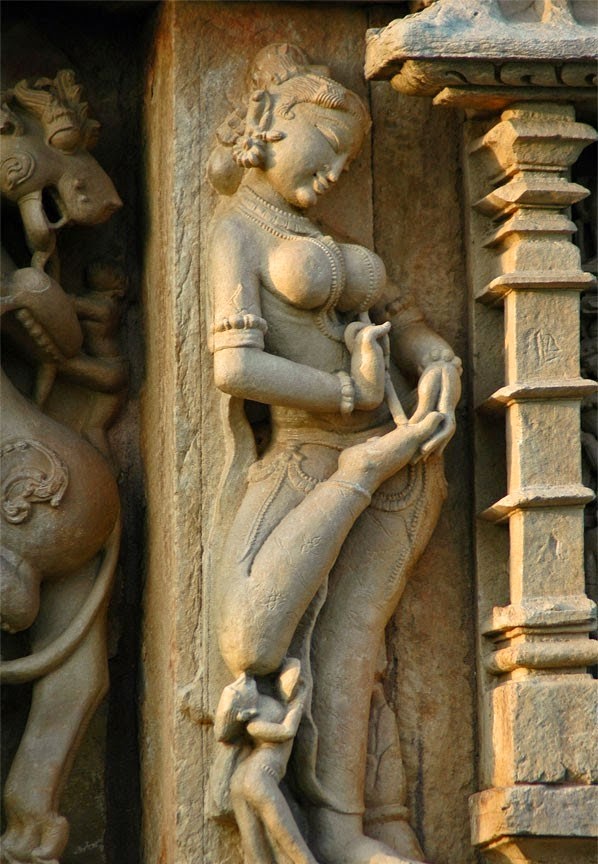
Many carvings on the temple wall show unnatural sex behavior either prevalent in the society those days or intending to be tutorial to one. Threesome, foursome, animal sex and mutual masturbation are clearly (and in some ways sickening too) boisterously displayed.


It makes us wonder why when a temple which was supposed to be a forbidden place for lustful thinking, been adorned like a book of sex-making on most of the walls. Was the Golden era too forward an era of thinkers? Was talking of sex within the premise of God and religion not a taboo then? Why was unnatural sex so endorsed? What was about ‘tantra vidya’ involvement in love making between kings and queens as in many places the role of a ‘tantrik’ and ‘yogini’ helping couples for the sexual acts prominently exposed.

Tantrik: The one with a beard and a carved headgear

This beautiful statue of Shakuntala is like some marvel of a rock. Here she’s shown taking out a thorn from her feet. One look at her expressions would make you feel the connect the sculpture must have made with the character at the time of rendering his job with a spindle. Another is one f in which she tries to arrange her dress after it  is disheveled by some love making act. 


The beauty of Khajuraho sculptures lies in the endearing manner in which expressions of characters have been captured. For example, in the picture below this surasundari (beautiful lady) looks at her image in the mirror, finds a gray hair and sulks. Now who’d think of depicting such an emotion that on a temple wall!!!


Here’s the sculpture of a Chandella queen putting surma (kohl) in her eyes.


Statue of Varah is the heaviest piece of rock in the site, a colossal monolithic image of the boar incarnation of Vishnu. The sculpture is carved with 675 miniature figures in twelve neatly carved rows on its body.

Varah: The boar incarnation of Vishnu at Varah temple, Kahjuraho

On the open terrace of the temple lies an important sculpture of Shardula (a warrior and a lion), a favorite theme in Chandella time.


The Eastern temples are though lesser known but just as important because they reflect a very different side of Khajuraho. The Brahma Temple is actually dedicated to Vishnu. There is also a stark difference between this and the typical western group temples, devoid of the ornate carvings, sensuous sculptures and elaborate architectures. Instead, it is a simple structure and is made of granite along with a pyramidal spire made of sandstone.

Evenings at Khajuraho turns into some romantic fiesta. Street side restaurant begin to shine with folk decoration, fairy lights and candle-lit dinning spaces. Display of clay sculptures and paintings adorn the market. Not to be missed is the two hours cultural programme full of folk dances, martial arts and songs organized by Madhya Pradesh Tourism in the town’s only auditorium.

M.P. Toursim Cultural Programme


One of the most memorable and heartwarming trips that I took with my soulmate. Discussing, researching, wandering through the remains from the past, mesmerized by sculpture art and debating over lustful interpretation of love the trip was a complete rejuvenation. We winded out trip with a light and sound show in the voice of Mr. Amitabh Bachchan at the Kandariya Mahadev underneath the moonlit sky.

Courtesy: india.travelsphoto.com


 As the tale echoed in the remains of Khajuraho walls, it forced us to bow down before the architectural grace and say, “Long live creativity”.

_________________________________________________________

This was about my soulful experience from the remains of an ancient erotic site? So what allures you about Khajuraho and the mystique behind it the most? Do let know. 


Friday, 26 September 2014

Munnar, Kerala: Of mists, mountains and waters

We are typical North Indians. Very used to hot summers, less waters, spicy food and speaking Hindi-English-Punjabi-Bengali-Gujarati-Bihari-anything but the Southern State languages. It was my sister who fell in love with a Malayali guy and married him. Did not even realize when in this entire process did the whole family, of elders, my daughters and a quondam maturing couple (My husband & I) also fell in love with a clan whose language sounded all-Greek, whose food was stark opposite of what we’d been having back home and whose land is a green-misty State full of rain, water and coastline. Love knows no boundaries. It just beckons like hell. A Malayali family of a newly acquired relative’s wedding called us back to Kerala and this time, we didn’t miss the chance to cover the misty hills of Munnar apart from the Arabian sea shores. Ah Kerala! Wish you were a stone’s throw away from our land.


This is a small piece from the Munnar memoirs.

Set at an altitude of 6000 ft in Idukki district of Kerala,  Munnar was the favored summer resort of the erstwhile British rulers in the colonial days and is now known for unending expanse of tea plantations - pristine valleys, water, Kannan Devan hills fully blossoming with exotic species of flora and fauna in its wild sanctuaries and forest, aroma of spice scent and mists that falls on your cheeks to rest in romance. Munnar, supposedly, has to have all of it.


Beneath is a view of the Haripad railway station from where we boarded a passenger train to the nearest junction of Ernakulam from where we would get a taxi for the uphill climb. A strikingly clean platform, quite unlike the Northern Indian railways where dealing with filth and dirt have become a man’s daily habit.


We began ascending the slope of Munnar at around four in the evening. While we meandered through the narrow roads, mist fell down blocking the driver’s view and the jungle around made creepy sounds fueling our appetite for adventure. By eleven in the night we were almost there. At 5000 ft. above the ground, near to our coy little resort, Aryanka, beside a huge waterfall. The invisible dark misty mountains had almost possessed us in its beauty by now.


Early in the morning, we started our escapade to the mystique of tea plantations. You know why Munnar is so different from other hill stations? Because it is not as much about the nature’s upbringing as about the sweat, labour and toil put in by thousands of labourers over generations (since 1870s) who’d put in their energy and soul in creation of tea estates. Munnar is but an impeccable example of man and nature culminating into one another and making lives of each other beautiful.


En route to topmost point of Munnar, we spotted the Kundala lake, an idyllic place in Munnar located Surrounded by rolling hills and valleys of dense forests, Kundala is known for the Kundala Arch Dam or Sethuparvati Dam and Kundala Lake. This was surreal! Like the one from some Hollywood movie shot. You've to see it to believe it.


Further on the way was the world famous Echo Point, behind a scenic lake bank. The children had a gala time shouting their lungs out to hear the hills reverberate your sound back to you.

"As a child, I would sit and ponder,
at the wooded areas, 
for their beauty relaxed me. 
The sway of the branches and whistling of the winds, 
as if they were calling my name.…"


Mattupetty (the Cattle Village) is a small town which has become a popular picnic spot among tourists visiting Munnar. Mattupetty is located at an altitude of about 1700 m above sea level, at a distance of 13 km from Munnar. 

After a day's hard work, we were almost there. At the Top Station, situated about 1700 m above sea level at about 41 km from town, on Munnar – Kodaikanal road and perhaps at one of the most scenic points of getting a breathtaking view of Munnar.


The place is bestowed full water, water and water all aroundn and through the forests. Elephant Lake or Anayirangal, Sita Devi lake, Attukal Waterfalls, Cheeyappara Waterfalls, Lakkam Waterfalls Pallivassal waterfalls, Thommankuthu waterfalls are among the prominent few. 

Standing somewhere tall in the vastness of plantation, underneath patches of torrential downpours are some soulful ladies. They take me awestruck with their determination, hard work and skill and I ask, “What’s it like to stand in rain for ten hours a day, work like machines, look out for leeches and still keep singing?”


Owing to the conducive climate, resource and vegetation, the place is home to variety of rare and endemic species of animals. One can get a glimpse of it at Rajamalai National Park, Chinnar Wildlife Sanctuary, located in the rain shadow vegetation of Western Ghats and Thattekad Bird Sanctuary. 


Finally, reached Pothamedu! Trekker’s paradise! Standing in the middle of all shades of green colour, brushing the skin with feathers of cool air and bidding the day a goodbye, the feeling is something like this -


"Have you seen the Sunset and Sunrise

And the Horizon that's a prize

How the colors mix and melt

And look as soft as felt…"


Munnar, my love, you keep beckoning!!! 


Related Posts Plugin for WordPress, Blogger...